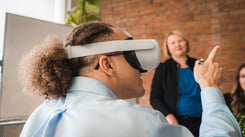
VR success stories are more common in the architecture industry than most people realize. Every design team faces the same communication challenge in client presentations. Non-design focused people have trouble learning a space from drawings or renders, even when the design is strong. Scale, proportions, and spatial flow can be lost in two dimensions. As a result, clients hesitate, conversations become repetitive, and teams spend time explaining rather than advancing the work.
This also causes stalls inside the firm. Teams often devote a fair amount of people and resources to create presentations. Designers have to create floorplans, static renders, markups, PDF decks, and model exports in the hope that the combined package will communicate the true concept of the project.
When clients are unsure and the team is spending time on presentations that do not remove that uncertainty, the entire project suffers. The design may be strong, but the communication is failing to convey your ideas.
We’ve put together a guide to real VR success stories in architecture featuring real Yulio clients. The firms featured in this guide solved these communication problems early. They adopted VR before it was common practice and built workflows that remove interpretation, accelerate decisions, and create immediate understanding.
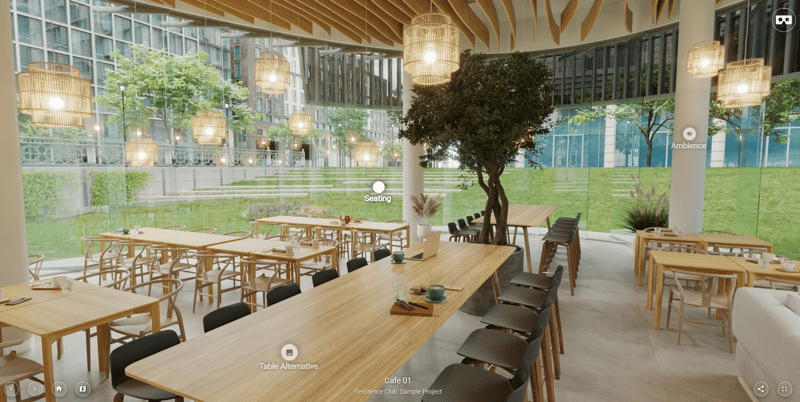
Key Insights from VR Success Stories
We have 5 key insights to share with you from this guide
1. Clients cannot fully visualize space from traditional drawings or renders. VR gives them true scale, proportion, and material context in seconds.
Diamond Schmitt Architects faced this when designing a massive conservation facility for Ingenium. The artifacts ranged from small hand tools to a 9-metre train car. On paper, the spaces made sense. In reality, the scale was hard to conceive.
Once they introduced VR, the client’s understanding shifted dramatically. What felt abstract in plan became clear in experience. The client engagement increased, and conversations became more productive because everyone could finally see and feel the space.
VR removes interpretation and replaces it with direct understanding.
2. VR makes clear that static imagery hides. Circulation, sightlines, lighting, and spatial flow become obvious when you step inside the design.
Forward Space also uses VR during RFP presentations when they want clients to grasp how it will feel to “live” in the space. Instead of flipping through slides, clients explore rooms, understand vistas, and see how areas connect. Circulation, sightlines, and adjacency are not details. They are decision drivers.
3. Emotional buy-in drives decisions. When clients feel the design, they commit faster and with more confidence.
Gensler experienced this during a retail prototype presentation to Skechers. The executive team reviewed the 2D deck and responded positively. The concept was understood. But the energy was measured.
Then the CEO stepped into VR. When he removed the headset, he said, “I liked the project before. Now I love it.”
That shift from approval to conviction changed the momentum of the project. What could have taken weeks to socialize internally gained immediate executive support.
4. VR reduces alignment time. Teams move from repeated clarification to immediate shared understanding.
Large projects rarely stall because of design complexity. They stall because stakeholders interpret drawings differently.
Before VR, Storr often required up to six meetings on major projects to align large institutional clients. Every stakeholder formed a slightly different mental model of the space. Conversations repeated. Clarifications multiplied
After introducing VR, those same review cycles dropped to two or three meetings. Alignment formed faster because everyone saw the same environment at the same scale.
5. VR strengthens presentations and wins work. Immersive clarity differentiates proposals and builds trust instantly.
Storr used VR to support a major university client navigating a complex, multi-phase project. Traditional presentations created hesitation. VR removed ambiguity. The result was more than $500,000 in awarded work.
Diamond Schmitt uses VR in donor presentations for healthcare and academic projects. Donors do not just see a lobby or gallery. They stand inside it. That emotional clarity strengthens the conversation around investment
To see how these insights were put into full action, check out the full resource to see the full success stories of these architecture firms.
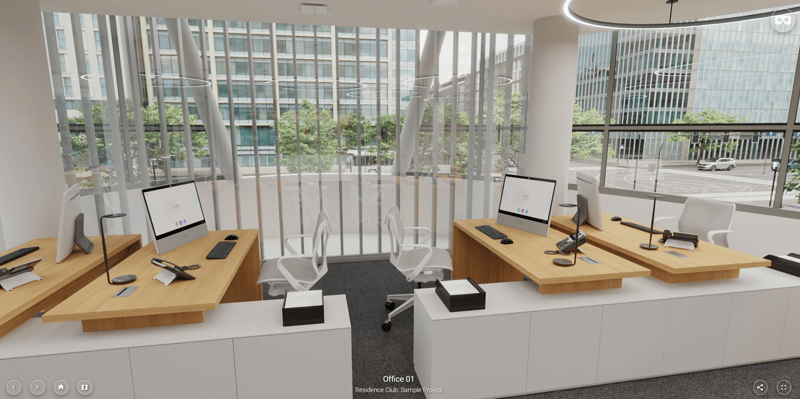
What To Do Next
If what we have show you today has interested you. Here’s what you can do.
-
Choose one active project. – Use a project you already have created, we want you to see just how easy it is to fit Yulio into your workflow.
-
Generate one VR-ready scene using the Yulio plugin or Jump trial. See how quick and easy it can be to create VR in just a few clicks. No major training, no long render times.
-
Load it on a headset (we highly recommend viewing in a headset for the full effect) but viewing on mobile or desktop is also highly impactful.
-
Step inside the space – See the clarity with your own eyes. You’ll see your project in a brand new light and a brand new dimension.
-
Share the same view with a client or teammate. – This couldn’t be easier with Yulio. All you need is to share a simple URL.
Whether you are reviewing early massing, refining materiality, presenting to executives, or engaging remote stakeholders, VR strengthens the entire communication process.
If you want to bring this level of clarity and confidence to your projects, you can begin with a single VR view. Build it, share it, and measure the difference in how your clients respond.