For years, immersive VR for Architecture was a luxury reserved for top-tier architecture firms. Winning high-profile clients with interactive 3D walkthroughs typically required expensive hardware investments: top-of-the-line gaming GPUs, tethered VR headsets, dedicated presentation rooms, and an in-house IT team to keep the entire pipeline from crashing.
For a 5-person boutique studio, that barrier to entry was steep. While small firms often deliver more agile, tailored design solutions than global firms, presenting those designs in static 2D renders or flat PDFs left a critical gap in client communication.
Cloud-based VR changed the playbook. By moving the heavy processing burden off local hardware and into the cloud, boutique studios can now deliver the same high-end, interactive experiences as Top 100 firms, without touching a $3,000 gaming rig or buying expensive headset setups.
The Hidden Cost of Traditional Architectural Rendering
In a boutique environment, every tool must deliver immediate value without draining resources. Traditional high-end rendering pipelines introduce friction at nearly every step:
-
Hardware Overhead: Running local VR engines requires specialized, high-performance workstations for every designer on the project.
-
Client Friction: Sending a traditional 3D model often requires clients to download large executable files or install custom software. This can be a non-starter for corporate boards or busy homeowners.
-
Iterative Delays: Re-rendering full static sets every time a client wants to compare material finishes creates unnecessary bottlenecks in early design phases.
When a client struggles to understand spatial volume, ceiling height, or sightlines from a flat image, decision-making stalls. The issue isn't the quality of the design; it's the friction in how the design is communicated.
How Cloud Rendering Changes the Equation for Small Firms
Cloud rendering strips away the technical complexity, turning VR from an enterprise-only hardware setup into a lightweight web tool integrated directly into your existing CAD workflow.
-
Zero Hardware Friction - By using cloud processing, your existing Revit or SketchUp models are converted into immersive 3D environments on remote servers. Designers don't need upgraded graphics cards, and clients don't need specialized headsets to explore the space.
-
Instant URL-Based Sharing - Instead of sending 50MB attachments or complex software links, designers share a simple web URL. Clients open the link on a tablet, phone, or standard desktop browser and immediately step inside the design.
-
Democratized Design Capabilities - A 5-person practice can pitch against major regional competitors with identical visual fidelity. When a small studio can offer interactive floor-plan navigation, embedded finish hotspots, and 360-degree spatial context, the focus shifts back to design quality rather than firm size.
.png?width=1014&height=266&name=Yulio%20Jump%20A%20D%20funnel%20-%20Google%20Docs%20(1).png)
Case Study: How Active Office Delivers Stunning Renders Simply & Fast
The Challenge
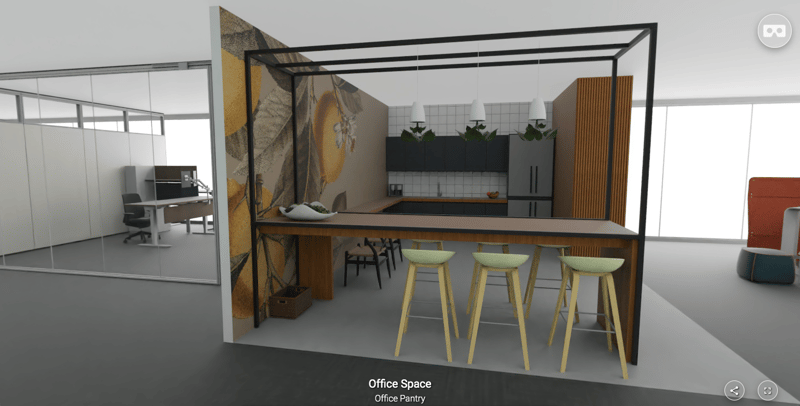
Active Office, an interior design provider, needed a fast, reliable way to communicate design intent and spatial layouts to clients without getting bogged down in lengthy rendering workflows. Producing high-impact visual presentation assets was essential to help clients visualize their new workplace setups and approve proposed layouts, but traditional rendering pipelines risked taking up valuable designer bandwidth.
The Solution
Active Office integrated Yulio Jump directly into their design workflow. By leveraging Yulio’s cloud rendering engine, their designers could automatically convert CAD models into photorealistic 3D/VR environments with minimal setup and lightning-fast cloud turnaround times.
Instead of waiting hours for local renders or sending static 2D images, the team could generate immersive VR experiences accessible via simple web links. Clients could virtually walk through the space on laptops, phones, or tablets, experiencing exact lighting, scale, and finishes in full context.
The Results
Stunning Visuals in Minutes: Active Office streamlined their rendering pipeline, generating photorealistic cloud renders and VR walkthroughs rapidly using Yulio Jump.
Streamlined Client Reviews: Clients gained immediate spatial clarity, allowing them to make fast, confident decisions directly within the virtual environment.
Low Technical Overhead: By removing local processing dependencies, the team avoided heavy hardware investments while keeping designers focused on creative work rather than technical troubleshooting.
Competing on Design, Not Hardware
Clients don't hire architecture firms for their rendering hardware. They hire them for their vision, expertise, and ability to execute. By eliminating hardware barriers and client software installs, cloud-based VR allows boutique studios to present their work with absolute clarity.
The playing field isn't just leveled. It's open to any firm ready to streamline how they share their designs.